

A particularly tricky part of law enforcement in Tokugawa Japan was the arrest of a man who is armed with a sword, without killing him and without injury to yourself. During the early and mid Edo period, a set of long-hafted restraining poles was used, known as mitsu-dōgu. One officer would use a sasumata 刺股, with a U-shaped forked head, to pin the opponent at the neck, waist or ankle. A second would use a tsukobō 突棒, with a T-shaped head, to push, trip or hold down the opponent. The third officer would use a sodegarami 袖搦, a long pole with several barbed hooks, used to entangle the sleeve of the opponent’s sword arm. It also appears in the sources under the names mojiri 錣/もじり, rōgebō 狼牙棒 and nejiritome 捻止.
The sodegarami acted on clothing rather than on the body. It was thrust into a sleeve, a hakama or the folds of a kimono and twisted, in order to lock into the fabric and holding the sword-wielding arm of the opponent at the end of two metres of oak. The Nippon Dai-Hyakka Zensho describes the type as a long-hafted closing-in implement with a head of hook-shaped iron barbs. There are iron spikes along the upper haft so that the pole itself cannot be seized, and a conical iron ishizuki 石突 caps the butt.
By the later Edo period, the mitsu-dōgu seem to have become more or less symbolic. Ueda City Museum records of its own tsukubō that by late Edo these were placed in front of the jishinban guardhouse, or merely carried when prisoners were paraded, kept purely for intimidation and thought not to have been used in practice. Nagoya City Museum notes of one of its three-piece sets that it was displayed at the Owari domain execution ground, and the Hirosaki domain office diary for Tenna 3 (1683) describes three labourers carrying the set of mitsu-dōgu tools in a prisoner procession. It is likely that the extant pieces in museum collections and elsewhere spent most of their life as parade and standing furniture rather than working equipment. Heavy combat damage is extremely uncommon in a genuine piece. The expected signature is the wear of storage, mounting and handling: stable oxidation, dirt in crevices, a worn ishizuki, and shrinkage in the wood.
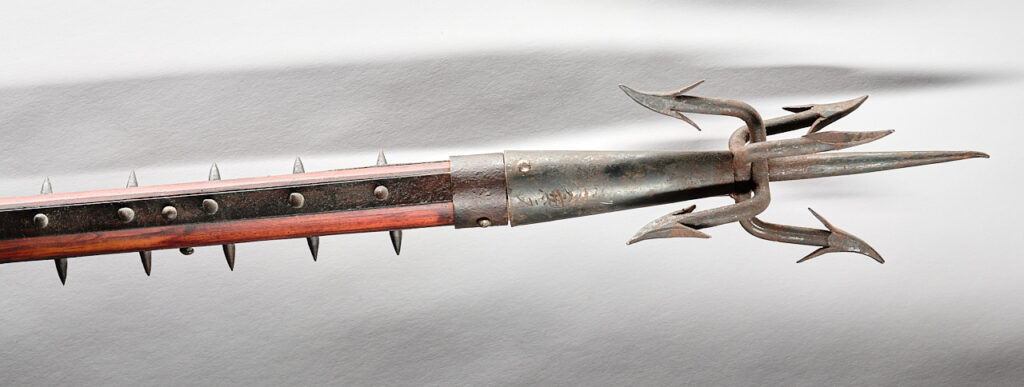
Front end of the sodegarami, engraving on the sleeve
The piece described here presents exactly the quiet, storage-type condition, although the oak shaft has been restored together with the rivets. It is quite unusual to find a sodegarami at such a level of completeness. The head (hosaki 穂先) contains an undamaged entangling section (karami 絡み) with three hooks that each have a rearward and forward-projecting point. There are three strips of spikes, set at roughly 120º around the haft. Interestingly, the Nippon Dai-Hyakka Zensho and Britannica Kokusai both describe the anti-seizure spikes as nails driven directly into the wood of the haft. On this piece they are not: they are integral with banded iron strips. The base of each spike connects into the strip surface with no seam, joint line, bead, spatter or heat discolouration ring; the appearance of the stripts is therefore consistent either with forge welding. The strips are fixed the the haft with three iron reinforcement bands (semeganemono 責金物) as well as (non-original) rivets. The ishizuku is a conical iron cap, matching the Mie Prefectural Museum description.
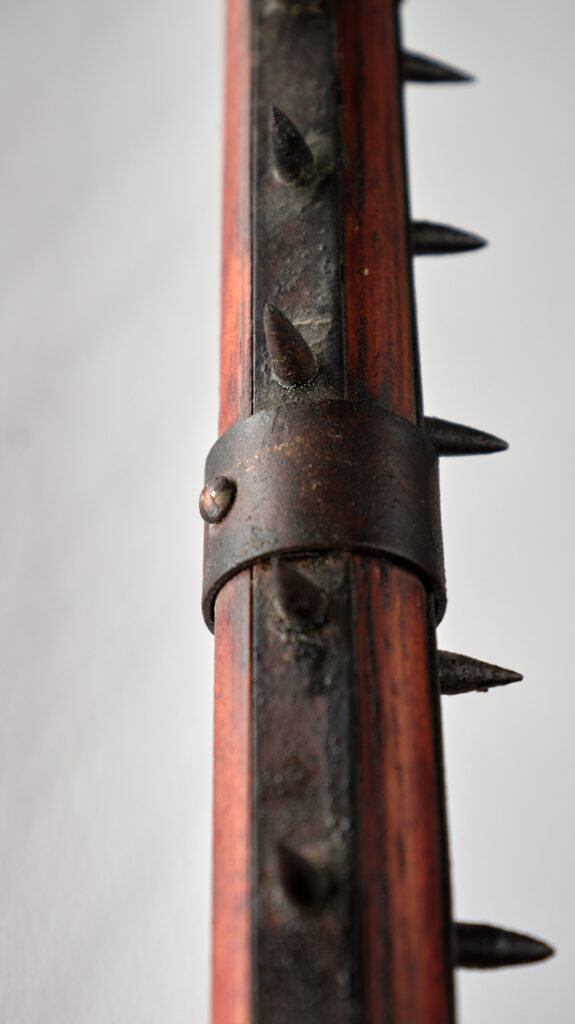
Anti-seizure spikes and reinforcement bands
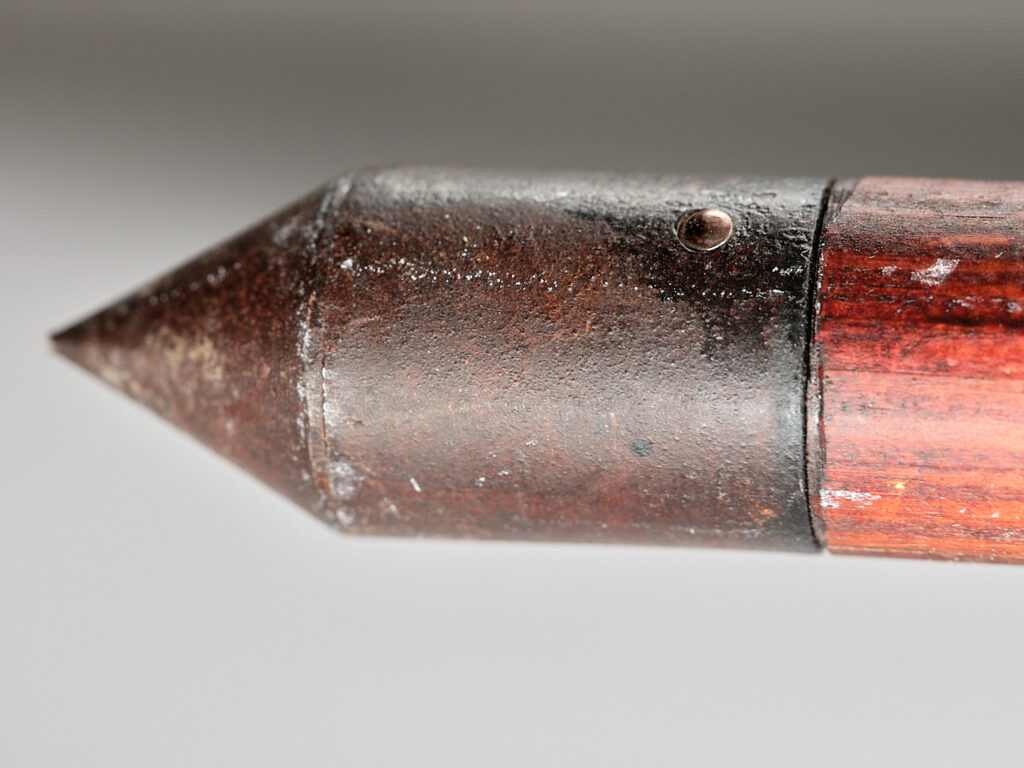
Ichizuki
Unusual inscription on the sleeve
The sleeve of this sodegarami (the tsutsu 筒) contains a mark which reads, vertically, top to bottom: 魚 ラ レ: the kanji gyo/sakana meaning “fish”, followed by two katakana, ra and re.
The sleeve carries a mixed oxide — patches of black magnetite-type film interspersed with red-brown scale — and the groove interiors of the engraving show that same mixed character rather than an oxide of their own.
Zoomable watermarked image of the sodegarami head.
The figure above supplies an internal age control, which is worth more than any external comparison because it is independent of lighting, white balance and observer. Three visibly distinct ages appear in one frame:
- The surface patina and the groove interiors — one generation, mixed black and red-brown.
- A bright, shallow abrasion immediately above the mark — bare metal, no chisel walls, no oxide within it.
- A bright peened rivet at lower left, this is not an original element and is part of a recent restoration that involved the haft and rivets.
What does the engraving mean? An administrative interpretation is plausible: 魚 as a fixed guard-post designator and ラ・レ as a rack code in the iroha sequence, together giving a specific post and rack number. In its favour, the form of the mark is consistent with an inventory system rather than a maker’s signature. A kanji followed by sequential kana is how one would expect a rack or post code to look. Arsenal-issue equipment was marked for accountability in Edo Japan: 番筒 bandzutsu, “numbered barrel” matchlocks issued by a lord to ashigaru musketeers, carry identification numbers struck on the firearm. However, marks on mitsu-dōgu are quite rare: of some fifteen institutional records I found, only Nagoya City Museum 692-0008 records an inscription — an incised 弥 on the lower haft of two of its three pieces. The Japanese auction record contains one sasumata described as 在銘 正重. I also have not found any published documentation of an iroha-sequence numbering system applied to sandōgu, or confirm 魚 as a post designator. Searches across Japanese museum databases, prefectural history archives and reference works returned nothing so far. Provenance and interpretation research is ongoing, and results will be published here as they come in.